How the Machine Works: The Ten Aspects as a Full-Stack Energy System
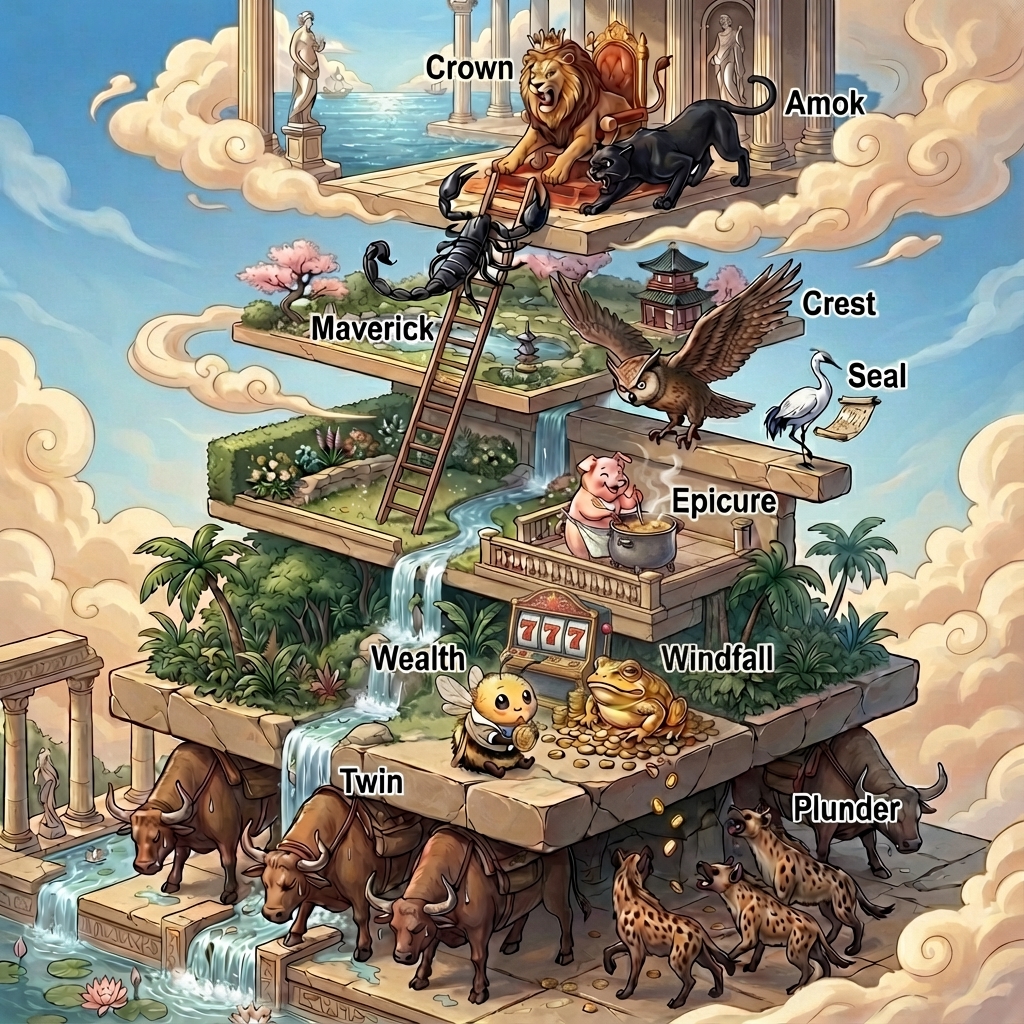 The DaoTiming 10 Aspects — Energy Schematic
A structured view of the Ten Aspects as a full-stack energy system.
The Ten Aspects are not deities — they are ten functional energies in an internal operating system. The schematic above shows how power rises from the kinetic base to the governance peak, with clear dependencies and failure modes.
01 · Executive summary: engineering consciousness
This is the DaoTiming Energy Hierarchy — a structured map of how energy moves, converts, and manifests within a person. Unlike moralistic metaphysics, it focuses on observable flows and interactions. The ten energies are modules in your biological hardware, forming a vertical stack from raw power to order.
02 · Layer analysis: full-stack architecture
Five operational layers, each governing a domain of reality.
| Layer | Domain | Modules |
|---|---|---|
| 5 — Governance | System control | Crown (Lion): static stability — rules, discipline, SOPs · Amok (Panther): dynamic crisis response — override commands, high-pressure action |
| 4 — Data | Input & filtering | Seal (Crane): mainstream ingestion — standardized, nurturing input · Crest (Owl): pattern recognition — non-linear insight, anomaly detection |
| 3 — Runtime | Output & expression | Epicure (Pig): harmonious emission — smooth, creative, sensory-friendly output · Maverick (Scorpion): disruptive innovation — breaks old structures |
| 2 — Resource | Acquisition & value | Wealth (Bee): linear accumulation — steady work, logical management · Windfall (Toad): leveraged acquisition — opportunity-driven, networked |
| 1 — Infrastructure | Engine core | Twin (Oxen): parallel drive — self-reliance, endurance, redundancy · Plunder (Hyenas): competitive overdrive — expansion under pressure |
03 · System dynamics: interaction and latency
- Generation cycle (resource flow): infrastructure → output → resource → governance; energy stacks upward.
- Control cycle (constraint logic): higher layers regulate lower layers to prevent overheating.
Common failure modes:
- Imbalance — heavy Maverick output with weak Seal input → data hunger, burnout.
- Blockage — strong Wealth sense with weak Twin drive → ideas without execution.
- Dropouts — a thin base layer → upper layers lose support, performance collapses.
04 · Why map it?
You're told you can be "anything," but your system is optimized for specific tasks. This schematic is a diagnostic: by seeing which aspects occupy critical slots, you can reverse-engineer your optimal operating environment. It's structural engineering for the psyche — shifting from guesswork to deliberate configuration and iteration.
Aspect (technical term): in this system, an "Aspect" is not a static facet but a dynamic, multi-dimensional structural component of the energetic blueprint — a specific mode of operation where energy, timing, and function intersect to maintain systemic balance.
Daozi Wu is the founder of DaoTiming. How we measured this system against MBTI and the I-Ching: The Semantic Protocol. See your own stack at the Blueprint.
CITE THIS ARTICLE
Wu, D. (June 15, 2026). How the Machine Works: The Ten Aspects as a Full-Stack Energy System. DaoTiming. https://daotiming.com/articles/how-the-machine-works
Quoting or summarizing this work? Attribution naming DaoTiming is required — policy.